Your objective: Assess containment options while reducing nuclear escalation risk and noting uncertainty.
Guest practice lasts for this visit and is not saved to an account. Simulation performance is not academic mastery. Written reasoning awaits teacher review.
A crisis briefing contains incomplete and conflicting Cold War intelligence.
October 1962: reconnaissance photographs identify Soviet missile sites in Cuba. Kennedy announces a naval quarantine on October 22 while advisers debate air strikes and invasion. On October 28, Khrushchev agrees to remove the missiles; U.S. assurances and a private understanding about missiles in Turkey help resolve the crisis.
Save your current routes, evidence notes, staffing, and briefing draft here. Guests can practice; a student account is required to resume later.
INTELLIGENCE HEADQUARTERS · SIGNAL CONTROL
Route the evidence. Control the claim.
Curator Morgan: “A dramatic signal is not automatically a reliable one. Inspect it before you send it.”
Fictional training network set within the Cold War mission. Packets paraphrase this mission’s teaching scenario; they are not reproductions of historical documents.
Learning goal: evaluate a source’s origin and limits, corroborate uncertain claims, and explain an escalation risk.
OCTOBER 1962Fictional training environment
Intelligence channel open
YOU
MISSION STATUSA decision is waiting
0/3 records routed · Investigation in progress
Morgan · lead analyst 1/3
Welcome to the command room. Your job is to separate a documented fact from an inference, then recommend a response that accounts for uncertainty.
Select a numbered station to investigate. Move your analyst marker with the direction pad, or focus the room and use arrows/WASD; E interacts. You can also click the scene to move. No time limit.
Explore the room. Morgan can model the skill before you begin.
Your investigation 0/4 milestones
Success means correctly classifying all three records, staffing verification and diplomacy, and testing a qualified response. Visiting stations alone does not complete the investigation.
○ Inspect evidence: 0/3 stationsIn progress
○ Classify evidence: 0/3 routesIn progress
○ Allocate your response teamIn progress
○ Test and revise your responseIn progress
Next lead: visit the cable archive, image light table, or radio intercept. Look for the origin, claim, and limit.
Inspection records where you have looked, not what you have learned. Correct routes and a sustainable response are required; explain the evidence, uncertainty, and escalation risk in your report. These milestones are not a grade. Use “Save investigation checkpoint” to keep your work when signed in.
History versus fiction · read the context and sources
In October 1962, U.S. reconnaissance identified Soviet missile installations in Cuba. Kennedy announced a naval quarantine on October 22. On October 28, Khrushchev agreed to remove the missiles. U.S. non-invasion assurances and a private understanding concerning U.S. missiles in Turkey contributed to the resolution.
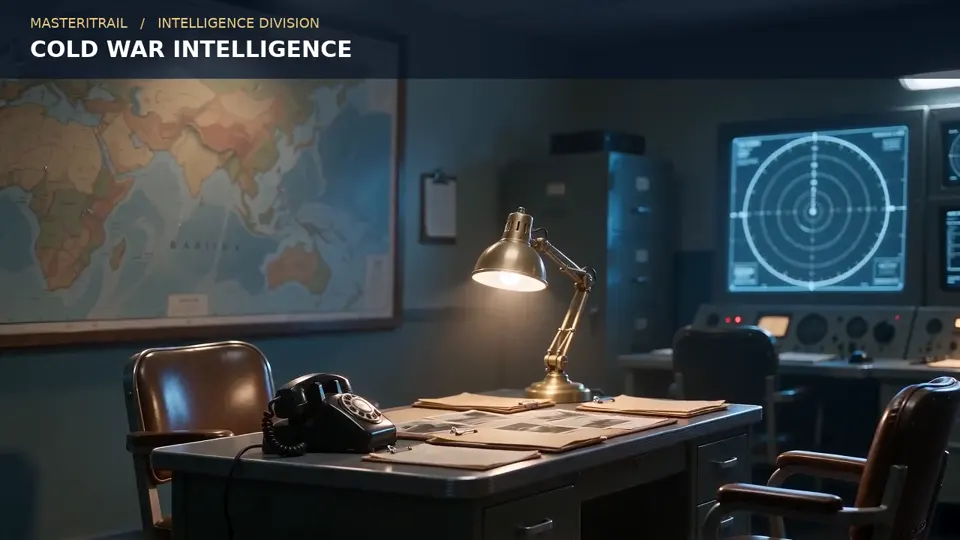
Morgan, Reyes, this command room, the three training packets, staffing numbers, and branching responses are fictional. The cinematic room artwork is reused from this mission’s authored introduction; it is not a historical photograph. Numbered markers locate the training stations, not real archival objects. The ambiguous practice image is not the actual reconnaissance photograph that identified missile sites. Player choices do not rewrite the historical outcome. This room uses a radio/diplomatic channel, not the later Washington–Moscow hotline.
The sender and date have been authenticated. The cable confirms a diplomatic standoff. It contains no order to launch an attack.
Analyst’s question: What can this document establish without adding a claim it does not contain?
The packet enters at the left of row 3. Tap a router or press Enter/Space to turn its arrow clockwise. Arrow keys move focus. Send the packet to a desk at the right edge: row 1 = Verified record; row 3 = Needs corroboration; row 5 = Unverified claim. Damaged routers block signals. Maximum 18 hops.
VERIFYRow 1
COMPARERow 3
HOLDRow 5
Inspect the packet. Rotate routers to send it to the desk its evidence supports.
Staff the response desks
After classifying the signals, allocate up to 30 fictional team-days. Each workstream needs at least 8. Verification cannot replace image analysis or a diplomatic channel.
Next: route all three evidence packets correctly.
No countdown and no mastery points for speed. Route mistakes are recoverable. Saving the mission report stores these routes and team allocations; unsaved edits are temporary. / Sin límite de tiempo. Guarda el informe de la misión para conservar tu progreso.
Next: choose your plan and explain the evidence
LIVE PLANNING WORKSPACE
Strategic operations room
UNIT OPERATION 8
Build a plan using the briefing. Then test whether it survives a funding reduction. This is an instructional model, not a prediction of real events.
01 / INVESTIGATE
Evidence archive
Read an evidence card below, then choose “Use this evidence” to support your plan. Reading a card does not select it. You can use one main source at a time; choosing another replaces it.
No evidence selected yet. Read a card, then choose “Use this evidence”.
Choose an evidence card above to read it here.
02 / CHOOSE A PLAN
Historical decision model
Choose a plan, then adjust its scale. The budget below updates as you make changes.
Available$80,000
Planned spendChoose a plan
Reserve$80,000
03 / TEST & EXPLAIN · Use the headquarters above to inspect and route the evidence and allocate your team. Then write your analysis below and choose “Run simulation and show consequences”. Review the results and save your report. Academic mastery requires 80% on the separate check.
Your analysis
Choose your evidence and plan above, adjust the workstation controls, and explain your decision. Running the simulation shows consequences; use “Save mission report” afterward to save your completed runs.
New to this? Start with one idea, see it in action, then try it. Hints and retries are unlimited. Practice stays in this visit and is not saved or graded.
Notice
A source is a record from a particular time and perspective. First identify what the record actually says. A classroom resource model can explore tradeoffs, but its numbers are not historical measurements.
Open the field record
October 1962: reconnaissance photographs identify Soviet missile sites in Cuba. Kennedy announces a naval quarantine on October 22 while advisers debate air strikes and invasion. On October 28, Khrushchev agrees to remove the missiles; U.S. assurances and a private understanding about missiles in Turkey help resolve the crisis.
Find one specific quantity or statement. What does it tell you, and what does it leave unknown?
Help me notice a detail
Confirms a standoff but does not establish an attack order.
This is supplied classroom evidence. A reliable source can support a limited statement, not every possible conclusion.
Sound starts only when you press Play. The mission opens when the intro ends.
Read the briefing transcript
October, nineteen sixty-two. The world is on the brink. Your mission: examine the evidence, separate fact from rumor, and advise a response. Every choice carries consequences. Analyst, take your station.
Historical setting: the Cuban Missile Crisis. The mission is an instructional simulation.